
I’ve been to jail. I’ve been to Rehab. I’ve had no money, no education, and no roadmap to follow.
Before I ever built my first company, I was the kid parents warned their kids about.
I’m telling you that because it doesn’t matter where you’re starting from. What matters is what you do next.
So here’s exactly what I’d do if I had to start a business from scratch today… In this new era of AI, no shortcuts skipped.
Step 1: Stop Looking for Your Passion. Find a Painful Problem.
Here’s the truth nobody wants to hear: passion doesn’t build businesses.
Solving painful problems does. People pay for painkillers. Nobody pays for a vitamin. The framework I use is called the Ikigai. It’s four questions to ask yourself.
You want to find the centre where they all overlap:
- What do you love to do? Not what you think you should love. What do you naturally drift toward?
- What are you good at? Think about the things people say to you unprompted… “You’re really good at that.” Those comments are data.
- What does the world need? What are people actively complaining about, struggling with, paying to solve and still not getting solved?
- What will people pay for? The market decides this, not you.
Most people treat this like a journaling exercise. I treat it like market research. The answers to those four circles? That’s your business idea.
Step 2: Build an Offer That Actually Makes People Want to Buy
You’ve got the idea. Now you need to turn it into something someone will hand you money for.
And here’s where most people blow it… they make the offer too complicated, too confusing, too detailed. A confused buyer never buys. Period.
Nobody buys a tool. They buy a solution to their pain. Wrap your offer in four clear components:
1. The Promise: What’s the transformation you’re selling? Not features. Not deliverables. Outcomes. Don’t say “I’ll set up your email sequences.” Say “I’ll get you 10 qualified leads in 7 days.”
The promise is the before and after. It’s not what you do. It’s what changes for them.
2. The Guarantee: Take the risk off them. Something like: “We get you 10 leads in 7 days or you don’t pay a cent.” The guarantee doesn’t just protect the client. It signals that you’re confident enough in your work to stand behind it.
If you’re not willing to guarantee it, why should they buy it?
3. Strategic Bonuses: Bonuses aren’t freebies. They’re objection killers. Think about the #1 concern your buyer has right before they pull out their credit card — and design a bonus that wipes it out. If you’re selling sales training, their first worry is “where do I find leads?”
Make a lead-finding system your bonus. Kill the objection before they ever voice it.
4. Internal Scarcity: Fake scarcity is dead. “Only 3 spots left!” Nobody buys that anymore. Real scarcity is internal. Here’s the question I use: “What’s the cost of not making this change over the next few months?”
Let them do the math themselves. When they realize what staying stuck is actually costing them, the urgency is real. You didn’t manufacture it… they discovered it.
On pricing: charge more than you’re comfortable with.
Underpricing attracts the worst clients and breeds resentment on both sides.
Use three tiers: an anchor price 5–10x your main offer, your main offer in the middle, and a cheap option that’s deliberately unattractive.
The middle option becomes the obvious choice.
Step 3: Go Find Your Buyers. They’re Not Coming to You.
I used to tell people: do five outreaches a day.
With AI, 50 is the new five — and they can be more personalized than anything you’d write yourself.
Here’s how I’d do it using a tool like Manus:
Step 1: Go to Manus, create an account, and say: “Ask me who my ideal customer is, what industry they’re in, what size of business, and what problems I solve.” Let it interview you. Feed it the offer you just built.
Step 2: Once it understands your ideal buyer, say: “Go find me prospects online. Deliver the name, company, contact info, and a personalized outreach message for each one.”
Step 3: Have the AI research each prospect — recent posts, news, job changes — and write an outreach message that mentions something specific about them. Something that only someone who actually did the research would know. That level of personalization makes your response rate go through the roof. And it took you minutes, not hours.
Step 4: Set it on a schedule — daily or weekly. Now you have a lead generation machine running automatically while you focus on everything else.
One more thing: before you go cold, work your warm network first. The people who already know you are 10x more likely to respond. Scan your contacts, your calendar, your social connections. Warm referrals close at a completely different rate.
Step 4: Selling Is Not Pitching. It’s Asking the Right Questions.
The question I get asked more than anything: “What do I say to get them to buy?”
The best salespeople don’t talk. They listen and then ask. Think of it like a staircase… At the bottom is hell, where your prospect is living now. At the top is heaven, the outcome they want.
Your job is to walk them up that staircase with questions. Not a pitch. This is what my Rocket Selling System does.
It has nine boxes:
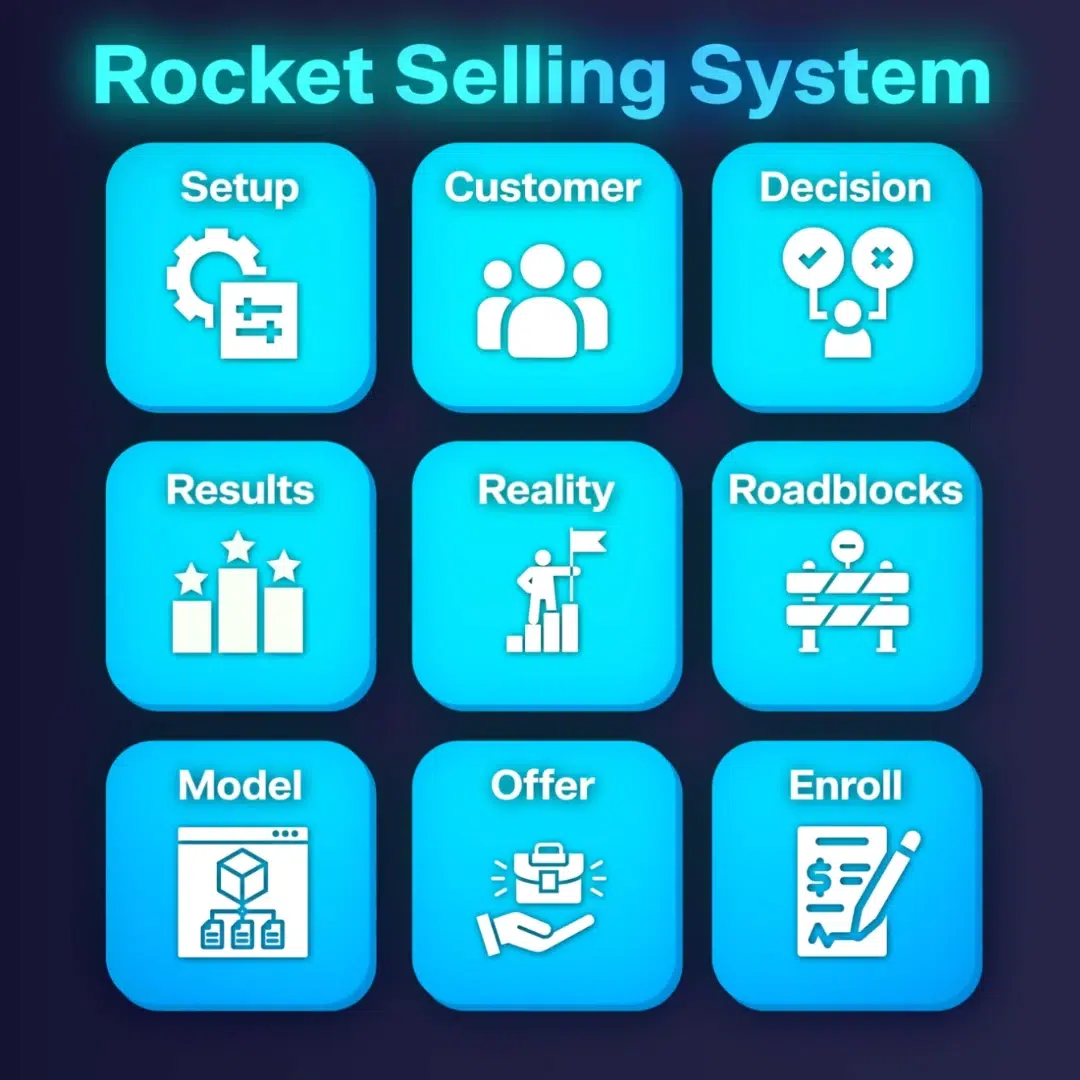
Box 1 – Setup (before the call): Use AI to prep. Type: “Here’s my prospect’s name, company, and role. Research them and give me a one-page brief: what they do, what problems they likely have, and what we might have in common.” Uncommon commonalities build trust faster.
Box 2 – Customer: Ask about their world. Who are their customers? How long have they been in their role? When they feel like you understand their context, they’ll trust your solutions.
Box 3 – Decision: Ask this and then shut up: “What made you decide now was a good time to have this conversation?” They’ll tell you their reasons for being there. Now, they’re selling themselves to you.
Box 4 – Results: Get them to dream. I’ll say: “Imagine it’s a year from now and we’re at your favourite restaurant. What are we celebrating?” Write down exactly what they say. Those are their real desires. Push to get the specific vision, no the generic stuff.
Box 5 – Reality: Get specific about where they are today. The more accurately you can describe their current frustrations, the more heard and seen they feel. The person who feels understood buys.
Box 6 – Roadblocks: Ask what’s been standing in their way. Keep a list as they talk. You’re building your case file.
Box 7 – Model: Now you talk. Explain your methodology. Not the features, the approach. Why does it work when other things haven’t?
Box 8 – Offer: Mirror everything back. “You told me you want [their outcome]. Right now you’re dealing with [their reality]. You said [these roadblocks] have been in your way. Did I get that right?” When they say yes: “Perfect… Well, because that’s exactly what we do. Where would you like to go from here?”
Box 9 – Enroll: “Based on everything you just shared, you’d be a perfect fit. To get started, all I need is a card to lock your spot. What card did you want to put that on?”
Practice before any real call.
Type into your AI: “Act as a skeptical prospect who runs [type of business]. I’m going to pitch you. Push back, give me real objections, don’t go easy on me.”
Do this 20–30 times.
By the time you’re on a real call, you’ve already navigated every curveball.
-DM